

Choosing the right range hood can feel overwhelming, especially when you encounter the term CFM. According to ASHRAE, proper kitchen ventilation requires at least 100 CFM for every 10,000 BTUs of stove output. Studies also show that inadequate ventilation increases indoor air pollutants by up to 400% during cooking. Understanding how to calculate CFM for a range hood helps you pick the right unit, protect your indoor air quality, and keep your kitchen fresh. This guide walks you through every step, formula, and factor you need to make a confident, informed decision.
What Is CFM and Why Does It Matter for Range Hoods?
CFM stands for Cubic Feet per Minute, and it measures airflow capacity. Essentially, it tells you how much air your range hood can move in one minute. A higher CFM rating means the hood pulls more air, smoke, grease, and odors out of your kitchen faster. Therefore, matching the right CFM to your cooking setup is critical for effective ventilation.
Range hoods with too little CFM leave smoke and grease lingering in the air. On the other hand, an oversized unit wastes energy and creates unnecessary noise. Manufacturers design each hood with a specific airflow range suited to different stove types. Consequently, knowing your CFM requirement protects both your health and your investment.
How to Calculate CFM for a Range Hood: The Core Formulas
Calculating CFM depends on whether you have a gas stove, electric stove, or a professional-grade range. Each type produces a different amount of heat and combustion byproducts. Fortunately, the industry provides straightforward formulas for each scenario. Use the right formula and you will land on a number that genuinely matches your kitchen’s needs.
CFM Calculation for Gas Stoves
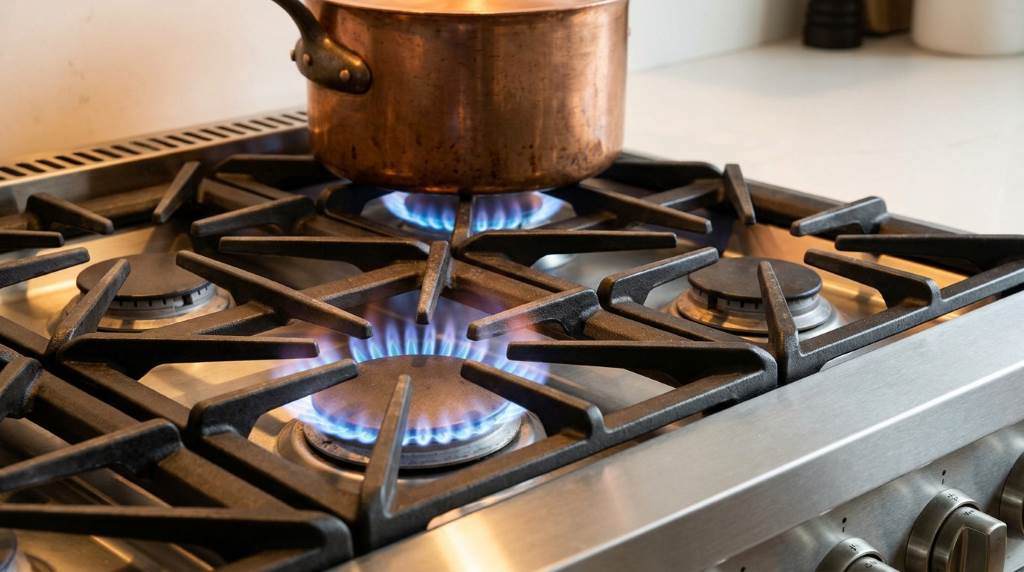
Gas stoves are measured in BTUs (British Thermal Units), which represent heat output. The standard rule is to divide the total BTU output of all burners by 100 to find the minimum CFM. For example, if your gas range produces 60,000 BTUs total, you need at least 600 CFM. This formula is widely recommended by the Home Ventilating Institute (HVI).
Add up the BTU rating of every burner on your stove to get the total. Most residential gas burners range from 5,000 to 20,000 BTUs each. A four-burner stove with an average of 12,000 BTUs per burner totals 48,000 BTUs. Therefore, that setup requires a minimum of 480 CFM for adequate ventilation.
CFM Calculation for Electric Stoves
Electric stoves do not produce combustion gases, so the calculation differs slightly. The standard guideline recommends 100 CFM for every linear foot of stove width. Therefore, a standard 30-inch (2.5-foot) electric range needs at least 250 CFM. This approach ensures the hood covers the cooking surface area effectively.
If your electric stove has high-output burners or induction elements, increase your CFM estimate by 20%. Induction cooktops generate less airborne grease than gas, but they still produce steam and odors. Always round up rather than down when you are choosing between two models. Giving yourself a buffer ensures you stay ahead of any ventilation shortfalls.
CFM Calculation for Professional or Commercial-Style Ranges
Professional ranges are powerhouses that often exceed 100,000 BTUs total. These units require significantly higher CFM ratings, sometimes between 900 and 1,200 CFM or more. Apply the same BTU-divided-by-100 formula but expect a much larger result. Additionally, you may need makeup air systems to compensate for the large volume of air being exhausted.
Commercial-style ranges also produce more grease-laden vapors than standard residential units. As a result, you should add a 25% buffer on top of your calculated CFM. For instance, a 100,000 BTU professional range needs at least 1,000 CFM, plus a buffer of 250 CFM, totaling 1,250 CFM. Always consult a ventilation specialist when dealing with high-output professional ranges.
Key Factors That Affect Your CFM Requirement
Beyond the stove type, several other variables influence how to calculate CFM for a range hood accurately. Ignoring these factors can lead to poor performance even with a correctly sized unit. Review each one before you finalize your purchase decision.
Duct Length and Number of Turns
Longer duct runs reduce the effective airflow of your range hood significantly. Every 90-degree turn in the ductwork reduces CFM by approximately 10%. A straight, short duct path delivers the most efficient ventilation. Therefore, plan your duct route carefully before selecting a hood model.
As a general rule, add 10% more CFM for every 10 feet of ductwork beyond the first 10 feet. Similarly, add 25% more CFM for every elbow or turn in the duct path. These adjustments ensure your hood performs at the rated level despite duct resistance. Skipping these calculations often leads to chronic underperformance.
Ceiling Height
Standard CFM calculations assume an 8-foot ceiling height. If your kitchen has 9-foot or 10-foot ceilings, you need to increase your CFM accordingly. Multiply your base CFM by 1.1 for 9-foot ceilings and by 1.2 for 10-foot ceilings. Vaulted or cathedral ceilings may require even higher multipliers, so consult a ventilation professional.
Higher ceilings mean more air volume that cooking fumes can spread into before reaching the hood. Consequently, a more powerful fan is needed to capture contaminants effectively. Many homeowners overlook ceiling height and end up with persistent cooking odors. Factoring it in from the start saves you from future frustration.
Cooking Style and Frequency
Heavy, frequent cooking with high heat requires more CFM than occasional light cooking. If you regularly stir-fry, sear meats, or cook with strong spices, bump your CFM up by at least 20%. Conversely, light cooking like reheating or steaming vegetables demands less airflow. Match your CFM to how you actually cook, not just to the stove’s maximum output.
Recirculating vs. Ducted Range Hoods: Does CFM Change?
Ducted range hoods vent air outside the home and are the most effective ventilation option. Recirculating hoods filter the air and push it back into the kitchen, which is less efficient. For recirculating models, choose a unit with at least 30 to 40% more CFM than a ducted model would require. This compensates for the reduced efficiency of the filtration process.
Recirculating hoods also require regular filter replacements to maintain performance. Carbon filters in recirculating hoods typically need replacement every three to six months. Without proper maintenance, even a high-CFM recirculating hood loses much of its effectiveness. Therefore, factor in ongoing maintenance costs when comparing hood types.
Common CFM Mistakes to Avoid
Many homeowners make preventable errors when calculating their range hood CFM. Avoiding these mistakes saves money, improves performance, and protects your indoor air quality.
- Ignoring duct resistance: Always adjust CFM for duct length and bends.
- Choosing the minimum CFM: Always add at least a 20% buffer above the minimum.
- Forgetting ceiling height: Adjust CFM upward for ceilings above 8 feet.
- Confusing rated CFM with actual CFM: Real-world airflow is usually lower than the manufacturer’s rated figure.
- Using one formula for all stove types: Gas and electric stoves require different calculation methods.
How to Calculate CFM for a Range Hood: Quick Reference Chart
Use this quick-reference guide to simplify your calculations:
| Stove Type | Formula | Example |
|---|---|---|
| Gas Range | Total BTUs divided by 100 | 60,000 BTUs = 600 CFM |
| Electric Range | 100 CFM per linear foot of stove width | 30-inch stove = 250 CFM |
| Professional Range | BTUs divided by 100, plus 25% buffer | 100,000 BTUs = 1,250 CFM |
| Recirculating Hood | Add 30-40% above ducted requirement | 400 CFM ducted = 520-560 CFM |
Conclusion
Now that you understand how to calculate CFM for a range hood, you have everything you need to make a smart, informed choice. Start by identifying your stove type and total BTU or footage measurement. Then factor in your duct layout, ceiling height, and cooking habits to refine your number. Finally, always add a safety buffer so your hood can handle peak cooking demands without struggling.
Take action today by measuring your stove, checking your duct path, and using the formulas above to find your ideal CFM. Share this guide with anyone who is remodeling their kitchen or upgrading their ventilation system. A correctly sized range hood is one of the best investments you can make for clean air, a comfortable kitchen, and long-term appliance efficiency.
Frequently Asked Questions
What is the minimum CFM for a range hood?
The minimum recommended CFM for most residential range hoods is 100 CFM for light-duty cooking.
How many CFM do I need for a 30-inch gas range?
A 30-inch gas range typically requires between 300 and 600 CFM depending on its total BTU output.
Is a higher CFM range hood always better?
Not necessarily, because an oversized hood can cause energy waste, excess noise, and pressure imbalance in your home.
Can I use a 400 CFM hood for a gas stove with 65,000 BTUs?
No, because 65,000 BTUs divided by 100 requires at least 650 CFM, which exceeds 400 CFM capacity.
Does a recirculating range hood need higher CFM than a ducted one?
Yes, recirculating hoods need 30 to 40% more CFM than ducted hoods to achieve comparable ventilation results.